


A hoarder cleanout rarely starts with a plan—it starts with a doorway you can barely walk through and a deadline you didn’t choose. The piles feel personal, the decisions feel endless, and the debris feels bottomless. This guide cuts through that overwhelm with a clear sequence for planning the work, sorting what stays from what goes, and clearing the resulting waste efficiently. You’ll need a loading crew or a willing contractor to do the physical emptying, but once the debris hits the curb, a properly sized roll-off container from Green Star Roll Off becomes the practical backbone of the whole operation.
What a Hoarder Cleanout Actually Involves
Sorting vs. Hauling: Two Different Jobs
A hoarder cleanout is never just a waste problem. It’s an emotional process tangled up with a massive physical one. Every box, bag, and stack of papers carries a decision: keep, donate, or toss. That decision-making is slow, often painful, and usually falls on the owner, a family member, or a cleanout crew hired for the job. None of that sorting work has anything to do with trucks or containers. It’s people, time, and hard conversations.
Then there’s the volume. These jobs rarely involve one cluttered closet. Think multiple rooms stacked floor to ceiling, a garage packed solid, a backyard buried under years of accumulation. Scale is the defining feature of these projects. A typical home cleanout might fill a pickup truck. A hoarding situation can produce ten times that in boxes, furniture, old appliances, and debris that’s been sitting untouched for a decade or more.
That’s why it helps to treat this as two separate jobs from day one: the thinking job and the hauling job. The thinking job is sorting, which takes people and patience, not equipment. The hauling job is getting the discarded volume off the property fast, and that’s where a roll-off container earns its keep. To match container size to the scope correctly, reviewing a roll off dumpster sizes guide before ordering saves a lot of guesswork later.
Worth saying plainly: Green Star Roll Off supplies the container, not the crew. If you need someone to physically sort through rooms, make keep-or-toss calls, or carry items out, that’s a separate hire entirely. A 15 or 20 yard residential rental works well once a family or a cleanout team has sorted items into piles ready to go. The dumpster handles the debris. It doesn’t handle the decisions.
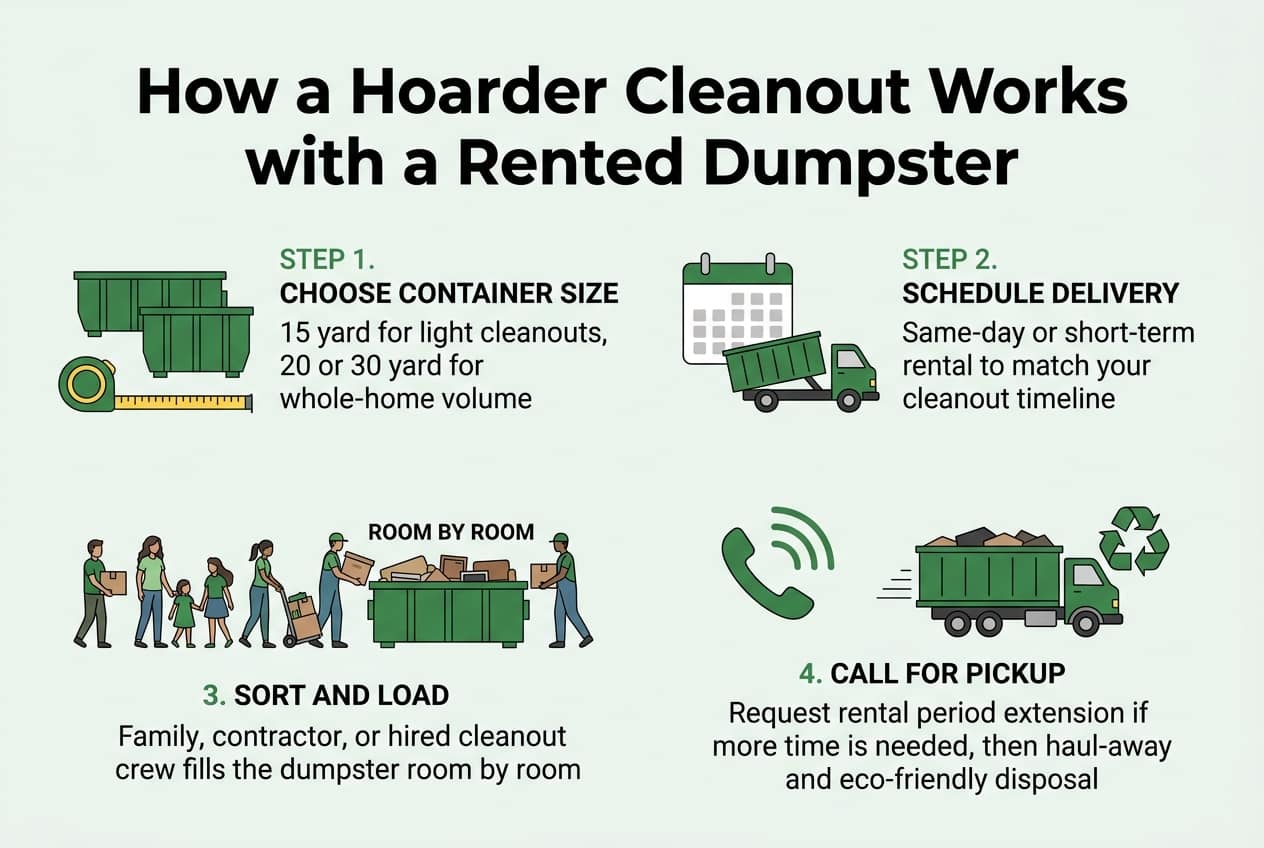
Planning Your Hoarder Cleanout Step by Step
Before you touch a single box, walk the property room by room. Write down what you see: furniture, paper piles, boxes, broken appliances, anything stacked floor to ceiling. This matters because scope drives size, and size drives cost. A single cluttered bedroom is a different job than a garage, kitchen, and three bedrooms packed solid. Guessing early almost always means a second rental later, and that costs more than getting it right the first time.
Once you’ve got a rough inventory, sort everything into four buckets: keep, donate, recycle, or discard. This is the slow part. It’s also the part that actually matters. Don’t rush it just to fill a container faster.
Building Your Support Team
Hoarder cleanouts are rarely a one-person job, and pretending otherwise just leads to burnout. The physical load is real, but the emotional weight is often heavier. Lining up help before you start keeps the project moving and keeps you sane.
-
Recruit family members or close friends who can commit to specific days, not just vague promises to “help sometime.”
-
Bring in a professional organizer if decision fatigue is the real obstacle, since they’re trained to keep sorting moving without judgment.
-
Consider a hoarding cleanout crew when the volume or emotional difficulty is beyond what family can safely handle.
-
Assign one person to manage donations and drop-offs so good items don’t end up tossed by mistake.
-
Set a loose daily goal, like clearing one room or one closet, so progress feels visible.
None of this needs to happen all at once. Small, steady sessions beat one exhausting weekend every time.
Timing Delivery Around Your Sorting Pace
Don’t book a container before sorting starts. An empty dumpster sitting around while you’re still deciding what to keep just wastes rental days. Instead, schedule delivery once the first discard pile is forming, so debris has somewhere to go immediately instead of piling up in the driveway or hallway. A 15 yard residential rental handles most single-room jobs where you or a helper will load it yourselves, while a 20 yard gives breathing room for multi-room cleanouts with heavier furniture. Reviewing general yard dumpster dimensions helps you picture how much a given size actually holds before you commit. Rentals include 10 days, with extensions at $20 a day, so you’re not boxed into a rigid deadline.
Before delivery day, confirm your placement spot. Driveways are usually simplest and permit-free. Street placement often requires a city permit, and Los Angeles rules vary by block, so it’s worth a quick call to check. Green Star Roll Off’s staff can walk you through local placement guidance, though filing the actual permit is on you. Getting this settled early avoids a truck showing up with nowhere legal to drop the container.
Choosing the Right Dumpster Size for a Hoarder Cleanout
Size is the first decision, and it’s easy to get wrong. Go too small and you’re paying for a second rental mid-project. Go too big and you’ve overpaid for empty space. The honest answer depends on square footage, clutter density, and how many rooms are actually packed floor to ceiling. Reviewing dumpster sizes against your actual room count before booking saves you from both mistakes.
Here’s a rough breakdown of what each size handles in a typical hoarding situation:
|
Dumpster Size |
Best For |
Typical Scenario |
Included Tonnage |
|---|---|---|---|
|
15 Yard |
One room, garage, or small apartment |
Single bedroom packed with boxes, bags, and furniture |
1 ton |
|
20 Yard |
A few rooms or a mid-size home |
Moderate density across kitchen, living room, and one bedroom |
2 tons |
|
30 Yard |
Whole-house cleanouts and estate cleanups |
Heavy volume throughout a multi-bedroom home |
3 tons |
|
40 Yard |
Extreme cases, multi-story homes, house plus yard |
Combined interior clutter and exterior debris or storage sheds |
4 tons |
Notice the tonnage column. That’s not a minor detail. Weight matters as much as volume in a hoarder cleanout, because paper, books, and water-damaged furniture are heavier than they look. A 30 yard container that’s only half full of soaked carpet padding and newspaper stacks can still hit its weight limit fast. Go over the included tonnage and you’re billed $95 per extra ton, so a quick gut check on material type before you order the dumpster is worth the five minutes it takes.
For a single cluttered room or a small apartment, the 15 yard option covers the job without excess cost. Whole-house situations with heavy density usually call for the 30 yard, especially when the home hasn’t been cleared in years. Extreme cases involving a garage, yard, and multiple stories often need the 40 yard, or a swap partway through. If you’re unsure, call and describe the home room by room.
hoarder cleanout Costs and What Affects Pricing
A hoarder cleanout isn’t one fixed price. It’s a stack of smaller decisions that add up: container size, how heavy the load gets, and how many days you actually need the thing sitting in the driveway. Knowing the pieces ahead of time keeps the final bill from surprising you.
Container size drives the base rate. A 10 yard lowboy, built for dense material, runs $650 flat for clean dirt or concrete. For general household trash or mixed cleanout debris, pricing starts at $600 for a 10 or 15 yard, climbs to $635 for a 20 yard, $650 for a 30 yard, and tops out at $700 for a 40 yard. Bigger isn’t always pricier per pound — it just holds more volume.
|
Container Size |
Base Price |
Tons Included |
Best Fit |
|---|---|---|---|
|
10 yd (lowboy, dirt/concrete) |
$650 flat |
N/A |
Heavy, dense debris only |
|
10 yd (household/construction) |
$600 |
1 ton |
Small, light rooms |
|
15 yd |
$600 |
1 ton |
Single room or garage |
|
20 yd |
$635 |
2 tons |
Several rooms of clutter |
|
30 yd |
$650 |
3 tons |
Whole-house cleanouts |
|
40 yd |
$700 |
4 tons |
Large estates, heavy volume |
Go over the included tonnage and it’s $95 per extra ton. Hoarded homes often hide weight in paper, books, or old furniture, so don’t assume light just because it looks like clutter. Every rental includes 10 days, with extra days billed at $20 each — useful since sorting always takes longer than planned. Pricing is all-inclusive: delivery, pickup, fuel, and environmental fees are baked in, no surprise line items later. Addresses beyond 10 miles from Reseda add $40 to $120 for distance.
One more thing worth saying plainly: the dumpster bill and any cleanout labor are separate matters entirely. If you’re hiring help to sort, pack, or haul items to the curb, that’s billed independently by whoever provides it.
Getting an Accurate Quote by Phone
Online calculators give you a ballpark. A phone call gets you a real number. Describe the material type, estimated weight, and how many days you’ll likely need — Green Star’s staff can match size to load and flag any distance fees upfront. Call 818-457-7711, Monday through Saturday, before you commit to a size.
Working Through the Sorting Process Safely
Sorting a hoarded home isn’t a weekend sprint. It’s a slow, methodical process, and rushing it is how people get hurt or make costly mistakes. Pick a system and stick to it.
Work one room or zone at a time. Trying to tackle the whole house at once leads to decision fatigue fast. You lose track of what’s sorted and what isn’t. Pick a starting point — a bedroom, a garage corner, whatever’s least overwhelming — and finish it before moving on.
Watch where you step, too. Years of accumulation can hide real structural problems: blocked exits, floors sagging under the weight of stacked boxes, piles ready to topple. Keep at least one clear path to every door at all times. That’s not optional. It’s the difference between a cleanout and an emergency room visit.
As items come out, sort them immediately into categories rather than building one giant undifferentiated pile. A simple four-way split keeps the whole project moving:
-
Keep — items the resident genuinely wants and has room to store, set aside in a clearly marked area away from the active work zone.
-
Donate — usable clothing, furniture, and household goods in decent condition that a local charity or thrift store will accept.
-
Recycle — clean cardboard, paper, scrap wood, and metal that shouldn’t take up space meant for true trash.
-
Dumpster — broken, soiled, or unsalvageable debris headed straight for the roll-off container.
Items That Cannot Go in a Roll-Off Container
Not everything belongs in a container, no matter how badly you want it gone. Old paint cans, household chemicals, propane tanks, and similar hazardous materials are prohibited in roll-off dumpsters, full stop. They need a licensed hazmat facility, not a steel bin. Loading them anyway risks fines and, worse, a fire or chemical reaction mid-haul.
Appliances and mattresses sit in a gray area. Most residential dumpsters, including a 15 yard rental sized for exactly this kind of job, can accept them — but freon-containing units and mattresses sometimes carry extra disposal fees depending on local handling rules. Don’t guess. A quick call to confirm before loading saves you a surprise charge later.
Coordinating a Dumpster With a Professional Cleanout Crew
Hiring a cleanout crew takes the physical sorting off your shoulders. They dig through rooms, separate what’s salvageable, and stage everything else for removal. But the crew isn’t hauling that debris away in their truck bed trip after trip — that’s wildly inefficient. The smarter setup is a 30 yard dumpster from Green Star Roll Off parked on site for the duration of the job, so everything designated for disposal goes straight from room to roll-off. No staging piles in the driveway, no second handling.
Before the crew shows up, settle where the container will sit. Driveway, curb, or alley — pick it and confirm it. Crews work faster when they’re not improvising a path around a dumpster that landed in the wrong spot. A clear, direct line from the front door to the container means less time carrying, more time sorting. It sounds minor. It isn’t — poor placement is one of the most common reasons cleanout days run long.
Crews rarely finish in a single weekend, especially with a heavily packed home. That’s where a long-term rental or a simple extension earns its keep. Every rental includes 10 days up front, and added days run $20 each — cheap insurance against a crew that needs an extra week. Call ahead at 818-457-7711 if the timeline looks uncertain; it’s easier to extend early than scramble at the deadline.
After the Cleanout: Disposal, Recycling, and Next Steps
Keeping the Space Clear Going Forward
Once the dumpster is full, what happens to the contents actually matters. Green Star Roll Off diverts usable materials, metal, cardboard, wood, through eco-friendly disposal and recycling rather than sending everything straight to a landfill. Many align this process with LEED standards for reporting, which matters if the property is part of an estate, a sale, or a business that needs documentation. Ask about this before booking. Not every hauler tracks it.
Cleanouts rarely finish exactly on schedule. Sorting through decades of belongings takes longer than anyone plans for, and that’s fine. If loading runs a few days past the original window, rental extensions are usually available based on availability, so you’re not scrambling to empty a container overnight. Worth confirming the extra-day rate upfront rather than after the fact.
Timing pressure is real too. Inspections, eviction deadlines, and pending sales don’t wait for anyone. Same-day or next-day delivery helps close that gap when a cleanout has a hard date attached. It won’t fix a hoarding situation overnight, but it removes one variable you don’t need to manage.
Placement rules in Los Angeles catch people off guard constantly. Curb placement, street permits, sidewalk clearance, the requirements shift by neighborhood. Green Star’s local knowledge can tell you what’s typically required, though filing the permit itself stays the customer’s job. Good guidance here prevents a fine that costs more than the rental.
The hardest part comes after the dumpster leaves. Without new habits, clutter creeps back in, often within months. Setting a simple rule, one item in means one item out, keeps surfaces clear. A short weekly reset, even fifteen minutes, stops small piles from becoming big ones again.
Choosing between hauling debris yourself and paying for extra labor really comes down to timeline, budget, and how much lifting you’re willing to do, so it helps to be honest about all three before committing to either path. A 15 or 20 yard container priced with good rates and delivered by a friendly driver can make a self-loaded cleanout surprisingly manageable, especially when questions get quick responses from a professional team along the way. Whatever you decide, matching the container size to the actual scope of the job tends to matter more than almost anything else in how smoothly the project goes.